
Week 3: Absolute Values – Day 5
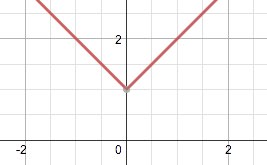
1. f(x) = |x| + 1
Minimum occurs at x = 0. The minimum value of f(x) is f(0) = 1.
Note that in general, the minimum of an absolute value is zero. But the function f(x) is an absolute value plus a constant.
2. f(x) = |x – 1|
Minimum value is f(x) = 0. This occurs at x = 1.
3. f(x) = 1 – |x|
This has a maximum value of 1 at x = 0.
4. f(x) = 1 – |2x|
This has a maximum value of 1 at x = 0. (Graph it and see.)
5. f(x) = |x| + |x – 1|
This has a minimum value of 1. This occurs for x in the range 0 < x < 1.
Bonus question: graph the function in #5. See the graph at http://desmos.com
Week 3: Absolute Values – Day 4
Solve for intersection points.
1. f(x) = |x| and g(x) = 1 – |x|
f(x) is an upward “V” with slopes 1 and -1. g(x) is a downward “V” shifted up one unit. There will be two intersection points.
One point: x = 1 – x which corresponds to 2x = 1 or x = 1/2
Intersection point is (1/2, 1/2)
Second point: -x = 1 + x which corresponds to -2x = 1 or x = -1/2
Intersection point is (-1/2, 1/2)
(The technique used here is the piecewise definition of f(x) and g(x)).
Piecewise definition of f(x): f(x) = x if x is >= 0, -x if x < 0.
Piecewise definition of g(x): g(x) = 1 – x if x >= 0, 1 + x if x < 0.
2. f(x) = |x| and g(x) = |x – 3|
f(x) is the standard upward “V” with slope 1 and -1. g(x) is the upward “V” shifted 3 units to the right. The expectation is for only one intersection point, where the slope 1 part of f intersects the slope -1 part of g. (Sketch the graph to see this.)
Solving: x = -(x – 3) = -x + 3 which means 2x = 3, or x = 3/2.
Intersection point is (3/2, 3/2)
3. f(x) = |x| and g(x) = |2x| – 4
f is the standard upward “V”. g(x) is an upward “V” with slopes 2 and -2, shifted down 4 units.
Expectation: two intersection points. Note: it is tempting to say there are 4 intersection points, but check the graphs and see that 4 points are impossible.
point one: – x = -2x -4 or x = -4 therefore point is (-4, 4)
point two: x = 2x – 4 or -x = -4 which means x = 4 therefore point is (4, 4)
4. f(x) = |x| and g(x) = |x – 3|/2
This time, one branch of g(x) intersects two branches of f(x). The left branch of g(x) which has slope -1/2 will intersect both parts of f(x); the right branch of g(x) which has slope 1/2 will not intersect f(x). Sketch the graph and see.
first point (right branch of f): x = -(x – 3)/2 which means 2x = -x + 3 or 3x = 3 or x = 1
Intersection point is (1, 1)
second point (left branch of f): -x = -(x – 3)/2 which means -2x = -x + 3 which means -x = 3 or x = -3.
Intersection point is (-3, 3).
5. f(x) = |x + 1| and g(x) = |x – 1|
Two upward “V”s, one shifted left one unit, one shifted right one unit. Expect one intersection point: between the right branch of f and the left branch of g. No others. (Sketch graphs and see).
right branch of f = x + 1 = -(x – 1) = left branch of g
x + 1 = – x + 1 which means 2x = 0 or x = 0.
Intersection point is (0, 1).
Week 3: Absolute Values – Day 3
Sketch the graphs of the following absolute value functions.
1. y = f(x) = |x| + 1
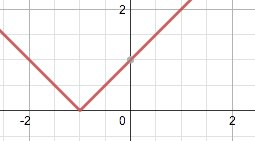
2. y = g(x) = |x + 1|
3. y = h(x) = 1 – |x|

4. y = p(x) = – |x – 2|

5. y = q(x) = 3|x|

Week 3: Absolute Values – Day 2
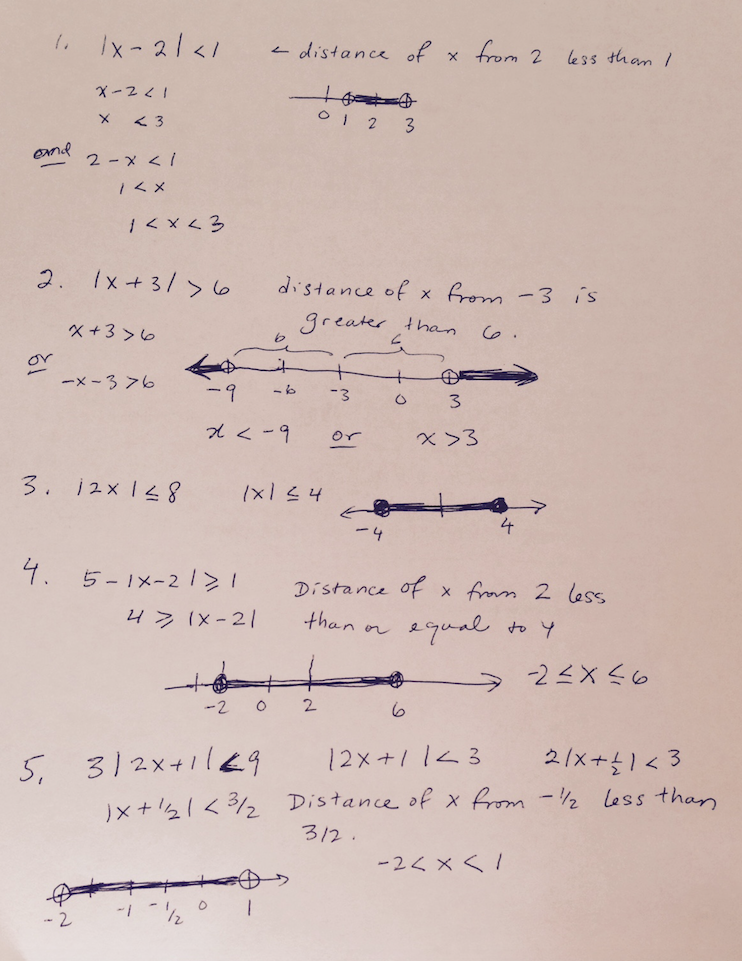
Week 3: Absolute Values – Day 1
Interpret the following absolute value expressions as distances.
1. |x – 10|
The distance of x from 10.
2. |x + 4|
The distance of x from -4.
3. |6x|
|6x| = 6|x|
This is 6 times the distance of x from zero.
4. |2 – x|
|2 – x| = |x – 2|. This is the distance of x from 2.
(It’s also the distance of 2 from x, which is the same thing).
5. |2 + x|
The distance of x from -2.